Integrated shift planning for SAP SuccessFactors. Automated and industry-proven.

Digital Workforce Scheduling in Industry: Why Generic AI Reaches Its Limits
How specialised algorithms secure production capacity and minimise legal risks
Industrial production processes require seamless planning. If a machine operator calls in sick at short notice, this immediately leads to personnel bottlenecks. Planners in these situations often resort to error-prone makeshift solutions: manual lists, time-consuming phone calls, and the manual correction of spreadsheets. Under time pressure, the risks of overlooking legal rest periods or collective agreement requirements increase. The pressure on those responsible grows to compensate for staff absences promptly and with minimal resources.
Therefore, more and more plant and shift managers are looking for technological solutions. Search queries for "rota AI" or "ChatGPT prompt for shift schedule" are rising across industries. Many planners hope to simply outsource complex planning problems to an Artificial Intelligence like ChatGPT or Gemini via text input.
Anyone replacing manual planning with a generic rota AI merely trades a lack of transparency for hallucinations. This article specifically points out where a pure rota AI fails and how specialised workforce scheduling software like shyftplan delivers reliable results.
Why Generative AI Does Not Write Shift Schedules
Systems like ChatGPT are based on large language models. These models calculate the statistically most likely next word in a text. They are excellent at drafting emails or summarising meetings. However, they fail to flawlessly resolve hard, multi-dimensional constraints.
Anyone trying to generate an industrial rota via a simple text-based rota AI immediately encounters several problems:
- Lack of system integration: A chatbot has no real-time access to your ERP system, your SAP landscape, or your time tracking. It plans in isolation based on the data you manually feed it at the moment of input. If an employee swaps their shift after the rota is created, the generated plan instantly becomes obsolete.
- Legally incorrect results: Working time regulations, industry-specific collective agreements, and individual company agreements demand strict compliance. When faced with contradictory parameters – such as acute staff shortages coupled with a mandatory rest period of 11 hours – generative AI often invents plausible but legally incorrect compromises.
- Ignored qualification matrices: In production, the sheer number of people is not what counts. You need specific specialists: the first aider, the certified welder, and the forklift driver on the exact same shift. General AI systems do not reliably map these critical dependencies during rotating absences.
- Data protection and compliance: Calculating a rota requires the processing of sensitive employee data. This includes names, qualifications, sickness records, and holiday periods. Entering this personal information into open AI models constitutes a breach of the General Data Protection Regulation (GDPR). The data leaves the secure corporate environment and feeds into the training of external systems.
- Lack of reproducibility: Generative models work probabilistically. With identical data input, the system frequently generates different shift schedules. For industrial manufacturing, however, reliable calculation logic is required. Under the same framework conditions, a specialised algorithm always delivers the same, mathematically optimal result.
- Limits in data processing: Language models have a technical upper limit for input data. When scheduling a large workforce over multi-week cycles with hundreds of variables, the amount of information quickly exceeds this capacity. The model loses context, which significantly increases the error rate during assignment.
Attempting to fix Excel chaos with generative AI ultimately consumes more time for subsequent checking than the original manual planning.
Specialised Technology for Workforce Management
As a specialised platform for HR management, shyftplan uses algorithms for mathematical optimisation instead of text generation. The software calculates a multitude of combination possibilities in fractions of a second and supports legally and professionally correct planning.
- Real-time data integration: shyftplan is directly connected to existing systems like SAP. The system constantly accesses up-to-date HR master data, absences, and holiday accounts. Planning is thus always based on the current actual state.
- Systematic checking of rule sets: shyftplan operates within a strictly defined framework. Legal and collective agreement requirements are consistently applied. The software prevents assignments that exceed maximum working hours or violate rest periods.
- Demand-oriented planning: The software links personnel requirements directly with production targets. If capacity utilisation changes, shyftplan automatically adjusts the required staffing.
Who Benefits from Integrated Shift Scheduling AI?
The introduction of specialised, AI-supported planning software structures complex planning challenges across all levels of the plant hierarchy.
1. Plant Managers: Securing productivity, controlling costs
The plant or production management focuses on the overall result. Downtimes due to understaffing or missing qualifications massively jeopardise productivity. At the same time, chronic overstaffing unnecessarily drives up personnel costs.shyftplan calculates personnel requirements with pinpoint accuracy. shyftskills precisely assigns the necessary certificates and skills to machines and workstations. The system exclusively schedules qualified personnel and proactively warns of expiring certificates. The result: you secure production and reduce expensive overtime and the use of external agency work to an absolute minimum.
2. Shift Managers and Planners: Automating processes, reducing planning effort
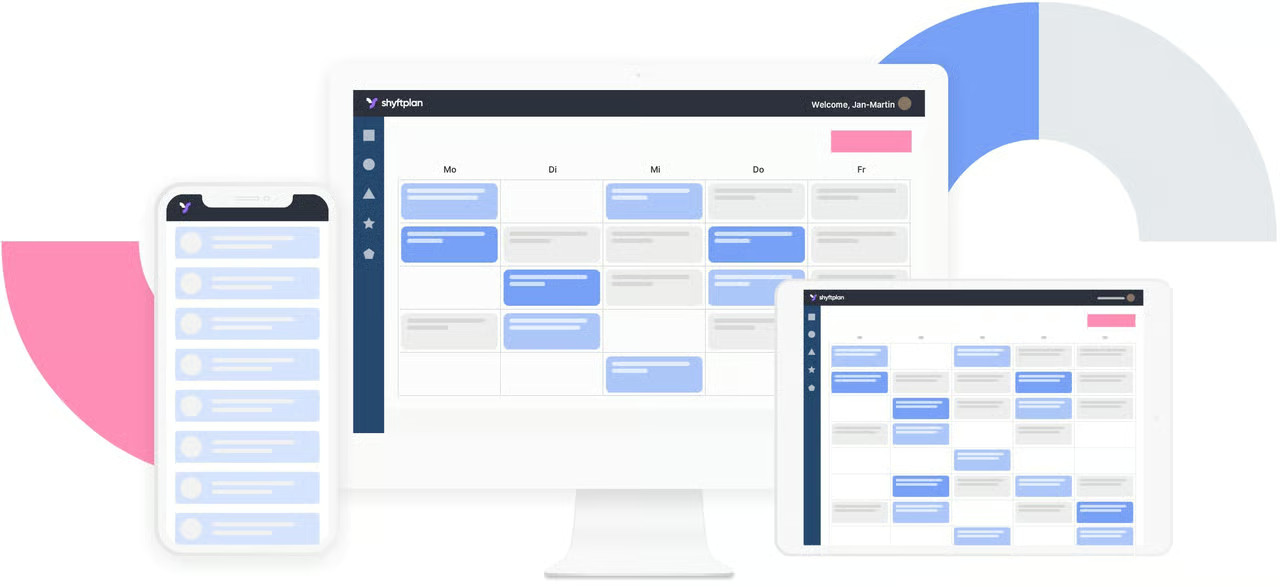
In practice, rota planning ties up valuable resources for the shift manager. Matching needs and filling shift gaps costs a lot of time. The automatic shift filling from shyftplan significantly accelerates this process. Absence management also becomes much more efficient. If an employee calls in sick, manual phone calls are eliminated. The shift manager releases the open requirement in the system. This specifically notifies suitable and available replacement staff via the mobile application. Employees apply with a click, and the shift manager confirms the assignment.
3. HR & Employees: Securing compliance, strengthening employee retention
For HR departments, compliance with legal requirements is the focus. shyftplan decisively supports company-wide compliance and provides security for future audits because everything is documented. The system prominently highlights conflicts with working time regulations or blocks impermissible assignments directly during planning.Furthermore, the platform contributes to employee satisfaction. The intuitive mobile application allows employees more participation in their daily work life. They organise shift swaps, log availabilities, or submit holiday requests conveniently via smartphone. Since the algorithm can incorporate soft factors and individual preferences into the calculation, more transparent processes are created. This increased fairness strengthens the long-term retention of skilled workers within the company.
The Right AI for the Right Task
The desire to use an intelligent rota AI for shift scheduling counters the acute skills shortage and growing cost pressure in industry. The choice of tool determines the operational stability of your plant.
Here is how your company specifically benefits:
- Process stability through integration: Seamless connection to ERP systems like SAP eliminates manual data transfers and ensures that your planning is always based on valid HR data.
- Legal certainty through automated checking: Consistent adherence to working time laws and collective agreements protects your company from liability risks and planning errors.
- Productivity through qualification management: By linking shift requirements with existing certificates, you fill every position with the correct expertise – this reduces downtimes and secures your output volumes.
Bring order to the complexity of your HR management and replace error-prone makeshift solutions with automated, legally compliant processes.
Why are generic AI models like ChatGPT not suitable for creating shift schedules?
Language models are based on probabilities and fail when confronted with the hard, multi-dimensional constraints of the industrial sector. They lack real-time connection to ERP or time-tracking systems, meaning they always work in isolation with outdated data. Furthermore, in the event of conflicts, they often invent legally impermissible compromises, ignore mandatory qualification matrices (e.g., the simultaneous presence of first aiders and forklift drivers), and violate the GDPR as soon as sensitive HR data is entered into open models.

How does specialised planning software ensure compliance with legal and professional requirements?
Unlike generative AI, specialised software like shyftplan uses algorithms for mathematical optimisation. The system operates within a strictly defined set of rules and continuously accesses up-to-date master data, absences, and holiday accounts via real-time interfaces (e.g., to SAP). It automatically checks every assignment against working time regulations and collective agreements, blocking any shifts that violate rest periods or for which the employee lacks the necessary machine certificates.
What added value does integrated workforce scheduling offer for the different levels of a company?
Plant managers secure machine availability through precise, qualification-based planning and reduce cost drivers like overtime or external agency work to a minimum. Shift managers are relieved of administrative tasks, as the system automatically communicates open shifts to suitable replacement staff via an app in the event of absences. HR and employees benefit from audit-proof, documented compliance and increased satisfaction, as the workforce is actively involved in the process through self-service functions (e.g., digital shift swapping, holiday requests).