Integrated shift planning for SAP SuccessFactors. Automated and industry-proven.

Skill Matrix and ISO 9001: How Companies Meet Legal Requirements
The Skill Matrix in Quality Management
A skill matrix is not only a tool for employee development, but also plays a central role in quality management. The DIN EN ISO 9001:2015 standard requires systematic qualification management to ensure that all employees possess or acquire the necessary skills required for their roles. But what specific requirements does ISO 9001 impose, and how can companies implement them efficiently?

ISO 9001: Requirements for Employee Competence
Section 7.2 “Competence” of ISO 9001 states that organizations must determine the necessary qualifications for employees and ensure they are met. This includes:
- Identifying the required qualifications for positions that impact the quality management system
- Documenting and providing evidence of existing competencies
- Planning and implementing measures to close qualification gaps, e.g., through training or external certifications
Importance for Quality Management
A structured documentation of qualifications is a critical tool for companies to meet ISO 9001 requirements. It supports legal compliance, reduces errors, and helps avoid costly penalties. For quality managers, it offers a transparent foundation for informed decisions and efficient training planning.
The benefits become especially apparent during ISO 9001 audits or recertification processes. A digitally maintained skill matrix can save significant time and effort, as not all qualification records need to be compiled manually. Instead, a central, well-maintained matrix allows for fast and efficient proof of all necessary qualifications. This not only reduces the risk of unpleasant surprises during audits but also strengthens the trust of internal and external stakeholders.
In practice, the skill matrix proves particularly valuable in companies with complex structures. It ensures that all employees have the required qualification levels for their tasks and enables proactive training planning to close qualification gaps in time. In short, the skill matrix makes a key contribution to process reliability, compliance, and quality assurance.
Requirements for an ISO 9001-Compliant Skill Matrix
A central element of an ISO 9001-compliant skill matrix is the structuring and breakdown of the competencies required for specific positions. Specifically, it includes:
- Competency Definitions: Detailed descriptions of the competencies necessary for each position. These may include both technical and soft skills essential for performing the role—such as machine operation or project management skills.
- Target-Actual Comparison: A systematic comparison of employees' current qualifications with the requirements of their respective positions. This helps identify skill gaps and plan targeted actions.
- Evidence Documentation: Careful recording of certificates, training, and other proofs. This includes tracking expiration dates to ensure critical qualifications are renewed in time.
- Updates: Regular reviews and updates of the matrix, especially after changes in roles, new legal requirements, or training completions.
How Smart Skill Matrices Support Quality Management
Smart skill matrices ensure that companies can easily meet ISO 9001 requirements for documenting and verifying competencies. Key features include:
- Global Overview: A central view shows the qualifications of all employees and the needs for specific positions. Managers can immediately see where action is needed.
- Matrix Filters and Customization: Managers can filter and adjust the skill matrix to quickly find relevant information.
- Qualification Requirement Syncing: Smart skill matrices pull qualification requirements for specific roles directly from ERP systems, making it easier to match them with existing personnel.
These features help companies save time and resources while ensuring compliance with regulations such as ISO 9001 and IATF 16949.
Automated Skill Matrices
Modern skill management software provides comprehensive features to make qualification management more efficient—especially when it comes to ISO 9001 compliance:
- Automatic Updates: Modern skill matrices sync qualifications, qualification categories, and assignments directly with existing shift planning and LMS systems (e.g., SAP). This significantly reduces manual upkeep and ensures alignment between qualification planning, personnel resource planning, and quality management.
- Notifications: Automated reminders notify users of expiring certificates or outstanding training needs. This enables companies to act proactively and avoid audit nonconformities.
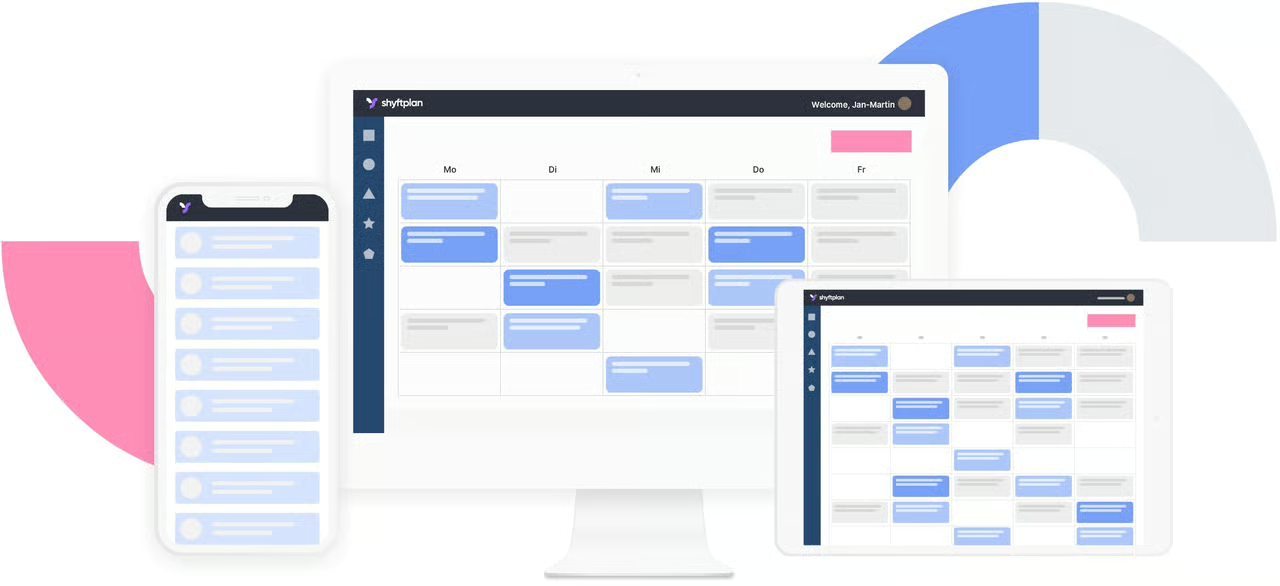
- Transparent Representation: Modern skill matrices provide a comprehensive overview of employees, their assigned qualifications, and their current status. This makes it easy to perform target-actual comparisons at a glance and identify development needs.
Challenges and Solutions in Implementation
Common Challenges with Skill Matrices in the Context of ISO 9001
Implementing a skill matrix comes with several challenges in practice, especially for large organizations with complex structures:
- Manual Data Maintenance: Maintaining the skill matrix manually is often time-consuming and error-prone. In organizations with many employees and locations, incomplete or outdated data can significantly impair efficiency.
- Complexity: Managing qualifications in companies with numerous roles and responsibilities often overwhelms existing systems. A lack of standardization in handling qualifications can lead to overlooked gaps or delays in addressing them.
- Documentation: Ensuring all legal and normative requirements are met requires great care. Missing documentation or unrecorded qualifications can lead to sanctions during audits.
- Lack of Communication Between Systems: Integrating the skill matrix with existing systems like HR software, shift planning tools, or LMS systems is often challenging. Different data formats, isolated solutions, and missing interfaces complicate data exchange and lead to duplicated efforts and redundant processes. Without integration, the full potential of the skill matrix remains untapped, and vital information may be lost.
Digital Solutions as the Answer
To overcome these challenges, more and more companies are turning to digital solutions. These offer more efficient management and significantly reduce the risk of errors:
- Real-Time Overview: Software solutions enable real-time synchronization of qualification data and send automatic reminders for expiring certificates or training needs. This ensures that all records are always up to date. This feature is especially critical before audits.
- Integration with Existing Systems: The skill matrix can be seamlessly integrated into existing ERP, LMS, and shift planning systems. This prevents data silos and ensures that all relevant information is current and centrally accessible. It also guarantees that only properly qualified personnel are assigned to tasks.
- User-Friendly Interface: Modern qualification management software features intuitive user interfaces. Thanks to clear structures, easy filtering options, and visually prepared dashboards, even complex skill matrices are easy to manage. Employees can easily add, update, or view new qualifications. Guided workflows, automated notifications, and a user-friendly design reduce administrative effort and significantly increase team adoption.
By using these digital tools, companies can not only manage their skill matrices more efficiently but also meet ISO 9001 compliance requirements with greater ease.
Efficient Implementation of ISO 9001 Requirements with a Skill Matrix
Using a skill matrix enables systematic recording, management, and updating of employee qualifications in line with ISO 9001 requirements. Through automated processes, transparent documentation, and integration with existing HR and quality management systems, qualification gaps can be identified early and addressed effectively.
Use our checklist to implement ISO 9001 requirements in a structured, practical, and audit-ready way.
How does IATF 16949 differ from ISO 9001 in skill management?
While ISO 9001 provides a general framework for quality management, IATF 16949 is specifically tailored to the requirements of the automotive industry. This means stricter requirements for traceability, defect prevention, and auditability— aspects that can be effectively supported by a comprehensive skill matrix.

What is ISO 9001?
ISO 9001 is an internationally recognized standard for quality management systems (QMS) that helps organizations standardize processes and continuously improve. It defines requirements aimed at increasing customer satisfaction, minimizing risks, and enhancing the efficiency of business operations. Companies certified according to ISO 9001 demonstrate reliability, transparency, and a strong commitment to quality.