Integrated shift planning for SAP SuccessFactors. Automated and industry-proven.

Industry in Transition: Flexible Working Time Models in Shift Operations
How industrial companies implement modern working time models – without losing efficiency
Flexibility is now a key expectation of many employees – even in the industrial sector. At the same time, manufacturing companies place high demands on reliability, shift coverage, and process stability. The term "flexible working hours" thus lies in a field of tension between employee needs and operational realities. For industrial companies, flexibility does not mean working from home or complete autonomy over working hours – but rather well-thought-out models that provide both planning reliability and individual flexibility. This article explores how flexible working time models can be implemented in shift operations without compromising production stability.

What do flexible working time models mean in an industrial context?
In industrial environments, the organization of working hours differs significantly from traditional office jobs. Shift systems, machine run-times, and cycle times create a rigid framework that appears to leave little room for flexibility. However, flexibility is possible here too—provided that the organizational and operational conditions are in place.
In practice, flexible working time models in shift operations primarily mean: adapting to different life phases, for example through part-time models. The ability to swap shifts with colleagues due to personal obligations is also part of it. For specific target groups—such as older employees or staff with caregiving responsibilities—reduced weekly working hours can be a sensible option. Digital tools and intelligent planning systems also help better coordinate shifts and make them plannable in advance.
Flexibility is not an end in itself. When implemented correctly, it can lead to greater satisfaction, lower turnover, and overall more efficient personnel planning. However, this requires structured implementation with clear rules and open, transparent communication.
Models for more flexibility in shift systems
Flexible starting times within shifts (flexitime)
Employees, for example, may start their morning shift flexibly between 6 a.m. and 8 a.m.—as long as a proper handover to the next shift is ensured. The ability to start or leave earlier provides personal flexibility.
Working time accounts
In production-intensive phases, employees work overtime, which is then compensated with time off during periods with less workload. Working time accounts allow for a long-term, balanced, and demand-oriented working time structure.
Part-time models and reduced full-time
Life-phase-oriented working hours, e.g., for parents, caregivers, or employees in training, can be implemented even in shift operations by reducing weekly working hours.
Shift swap options
Through digital tools, employees can swap shifts among themselves if they have private obligations. Final approval is given by the supervisor to ensure operational processes remain stable.
Preferred shift schedules
Employees can indicate preferences for certain shifts or days off. These preferences are taken into account during deployment planning as far as operationally feasible.
Flexibility with on-call shifts in shift operations
On-call shifts—also known as reserve shifts—are additional shifts that employees can take on beyond their regular working hours. They are often used to cover short-term absences or to respond flexibly to increased staffing needs.
For companies, on-call shifts offer an efficient way to absorb bottlenecks while keeping planning stable. For employees, taking on these shifts allows for more flexible work schedules and the potential to earn additional compensation.
The specific conditions for on-call shifts—such as pay, crediting to working time accounts, the maximum number of shifts allowed, or whether participation is voluntary—are typically defined in employment contracts, company agreements, or collective bargaining agreements.
Despite their benefits, on-call shifts require careful management. For employees, regular availability can become an additional burden, especially if short-notice assignments become routine. It is therefore essential that usage is clearly regulated, communicated transparently, and designed in compliance with labor laws. Only then can the balance between operational flexibility and individual planning security be fairly achieved.
Flexibility through 4-shift and 5-shift models
In addition to individual options like part-time work or shift swapping, structured multi-shift-systems — such as the 4-shift or 5-shift model—provide a reliable foundation for more flexibility in shift operations.
The 4-shift-model involves four rotating teams, ensuring continuous 24-hour operations. The even rotation provides regular rest periods and better planning of working hours. Overtime and workload peaks can be significantly reduced—while maintaining production reliability.
The 5-shift-model uses a fully continuous system with five rotating groups. It enables 24/7 production while reducing the individual workload. The additional relief shift creates more days off and often shorter weekly working hours—an advantage, especially for employees with family or health-related needs.
Both models provide a stable foundation for modern work scheduling. They can also be ideally combined with other flexible elements like preferred shift schedules, shift swaps, or on-call shifts—offering a balanced mix of operational continuity and individual planning freedom.
Challenges for plant management and production planning
The introduction of flexible working time models in shift operations presents several challenges for planning and operations managers:
- Reliable shift coverage: Despite swap options and part-time models, continuous shift coverage must be ensured.
- Technical constraints: Machine run-times, maintenance intervals, and cycle specifications limit flexibility in production planning.
- Legal basis: The Working Hours Act and recent rulings on time tracking must be strictly observed to avoid legal risks.
- Increased effort for spontaneous changes: Without suitable digital tools, short-term changes can quickly turn into planning pitfalls.
Achieving flexibility through digital shift scheduling
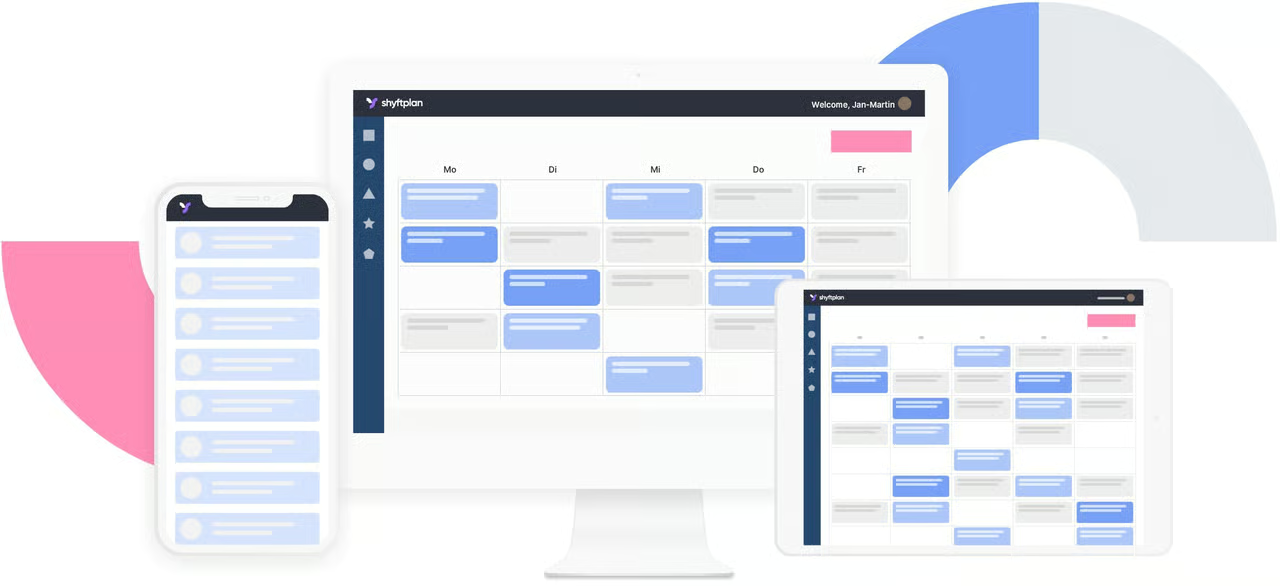
Digital shift scheduling tools offer an efficient way to meet the challenges of flexible working time models in shift operations—while ensuring legal compliance and reducing planning effort. They provide the necessary operational flexibility and minimize susceptibility to errors.
Key advantages of digital shift schedulers:
- Real-time planning & transparency: All parties involved have access to the current shift schedule at all times, so changes are immediately visible.
- Self-service features for staff: Preferences, shift swaps, and vacation requests can be submitted and managed directly via digital systems.
- Automated rule compliance checks: Digital systems automatically verify compliance with legal requirements, such as break times and maximum working hours.
- Optimizing on-call shifts with digital tools: With clear visibility and flexible adjustment options, employees can respond more quickly to short-term changes—enhancing both flexibility and shift plan efficiency.
How to successfully implement flexible working hours in shift operations
Flexible working time models are feasible even in industrial shift operations—provided suitable organizational concepts and digital tools are in place. Digital solutions like shyftplan make it possible to align individual employee needs with operational requirements. Whether it's part-time models, shift swaps, or on-call shifts—a structured digital shift scheduling system creates transparency, reduces planning effort, and improves the balance between work and private life.
Curious how this could work in your company?
Book a demo with our experts and discover how shyftplan can help you implement true flexibility in your shift scheduling — without compromising operational stability.
What are the legal regulations regarding working hours (ArbZG)?
In Germany, working hours are regulated by the Working Hours Act (Arbeitszeitgesetz – ArbZG). The law protects employees' rights in the organization of working time and aims to ensure safety and health protection. Working time, as defined by the ArbZG, is the period from the beginning to the end of work, excluding rest breaks (§ 2 Para. 1 ArbZG). According to §3, the maximum actual working time is limited to eight hours per working day, which may be extended to ten hours in exceptional cases. Break times are also strictly regulated: after six hours of work, a 30-minute break must be taken, and after nine hours, a 45-minute break is required.

Who is allowed to view the shift schedule?
Regarding data protection, the law is clear on work schedules: not every employee is entitled to view the entire shift schedule. Similarly, every employee has the right to prevent the publication of the schedule—even within the company.
What types of companies is shyftplan suitable for?
shyftplan is designed for companies with a three- to five-digit number of shift employees. If needed, shyftplan can also be used for companies with fewer employees. However, please note the minimum price of €700 per month.