Integrated shift planning for SAP SuccessFactors. Automated and industry-proven.

SAP Shift Planning: Efficient Workforce Management with shyftplan and SAP
Seamless integration of digital workforce management into your existing SAP systems. Our certified interfaces enable easy connectivity and error-free bidirectional data exchange.

The shortage of skilled labor has fully arrived in the manufacturing industry. Machines and, in some cases, entire production lines are increasingly grinding to a halt, while manufacturers face intense international price and competitive pressure. Against this background, production efficiency is a central factor for competitiveness and future viability. In the manufacturing industry, the available workforce is far more than an abstract cost factor—it is a scarce resource that directly impacts productivity.With shyftplan, one of the world's few SAP.io members, shift planning in your company can be completely digitized and automated. Our software utilizes actual data from digital time tracking, attendance, and absences to create demand- and employee-oriented shift schedules. Learn here how to use your existing SAP landscape as a stable foundation while agilely optimizing your operational processes on the shop floor.
Technical Implementation: What Does the Integration Look Like?
SAP Personaleinsatzplanung – The Bridge Between ERP and the Shop Floor
Classic Enterprise Resource Planning systems form the indispensable backbone for global HR processes, finance, and central master data management. However, when it comes to the highly dynamic, daily management of hundreds or thousands of workers in complex shift models, conventional structures hit their functional limits. A modern sap personaleinsatzplanung demands real-time agility that rigid core systems alone often cannot provide.If an employee drops out at short notice, the system must react within minutes, check qualifications, cross-reference statutory rest periods, monitor collective bargaining requirements, and simultaneously inform the affected workforce via mobile notifications. This is exactly where shyftplan comes in: By deploying an agile planning layer on top of your existing SAP architecture, you transform static data management into proactive, automated workforce management.
Combining SAP Time Management and Shift Planning Meaningfully
SAP Time Management (traditionally anchored in the SAP HCM module or modernized in the cloud) has secured standardized, legally compliant core HR processes for decades. Its strengths lie in precise time tracking, the automatic calculation of tariff-based premiums, and the clean maintenance of time accounts. In harsh everyday industrial operations, however, using it exclusively for operational shift planning frequently leads to problematic shadow processes:
- Sluggish absence management: Shift changes are cumbersome and slow. If a colleague falls ill or someone wants to swap a shift, this must first be reported via paper or email and then manually updated in SAP.
- Lack of transparency on the line: Foremen, supervisors, and shift leaders in production usually do not have direct SAP write access. Due to a lack of visual alternatives, planning is done via confusing Excel spreadsheets.
- No overtime forecast: Time management documents overtime balances precisely in retrospect, but does not provide planners with an automated forecast to preemptively prevent the uncontrolled accumulation of extra hours. Equal distribution within the team and unplanned forfeiture of hours are the result.
By directly linking SAP Time Management and shyftplan, you solve this problem sustainably. The integrated planning tool reads absences, vacation entitlements, and time account balances from SAP in the background and uses them as a reliable validation baseline for AI-supported shift planning. Both systems are utilized for their original use cases, which actively contributes to better utilization, reduced correction loops, and legally secure documentation.
AI-Powered Shift Planning with SAP S/4HANA
In intelligent manufacturing plants, production control and workforce scheduling must never operate in isolation from one another. If production requirements and personnel deployment are not synchronized, bottlenecks and line stoppages are inevitable. As a data-driven ERP system, SAP S/4HANA delivers precise specifications for machine utilization and order volumes. shyftplan merges these production data directly with personnel data.
Real-Time Synchronization with SAP PP and PP/DS
Via standardized communication channels, requirements from SAP Production Planning (PP) and Production Planning and Detailed Scheduling (PP/DS) are transmitted directly to shyftplan in the form of required hours. The software maps complex work areas, manufacturing lines, and specific machines. The system recognizes exactly how many qualified workers are needed at which plant at any given time. In return, the real-time machine utilization from shyftplan is fed back into SAP S/4HANA.
AI-Based Replacement Management for Personnel Shortages
If a worker drops out spontaneously, the integrated algorithm calculates the optimal replacement within seconds. The system factors in qualifications, working time regulations, and legal requirements (such as rest periods or maximum working hours) and suggests suitable replacement workers based on these criteria. The GDPR-compliant processing and synchronization of personnel data is ensured natively by the system.
SAP SuccessFactors Manufacturing and Core-HR Integration
SAP SuccessFactors forms the modern cloud suite for holistic talent and human resource management. While Employee Central (EC) is excellently geared toward standardized, globally rollable HR processes, shift work in industrial manufacturing requires maximum operational flexibility.The combination of shyftplan with SAP SuccessFactors creates a high-performance total solution:
- Central HR Core: Employee master data is maintained exclusively in SuccessFactors and automatically synchronized with shyftplan. Data inconsistencies and duplicate data maintenance are completely eliminated.
- Automated Vacation and Absence Reconciliation: If a shift worker submits a vacation request or reports absent, the system reconciles the contingents in the background and provides AI-supported suggestions for replacements.
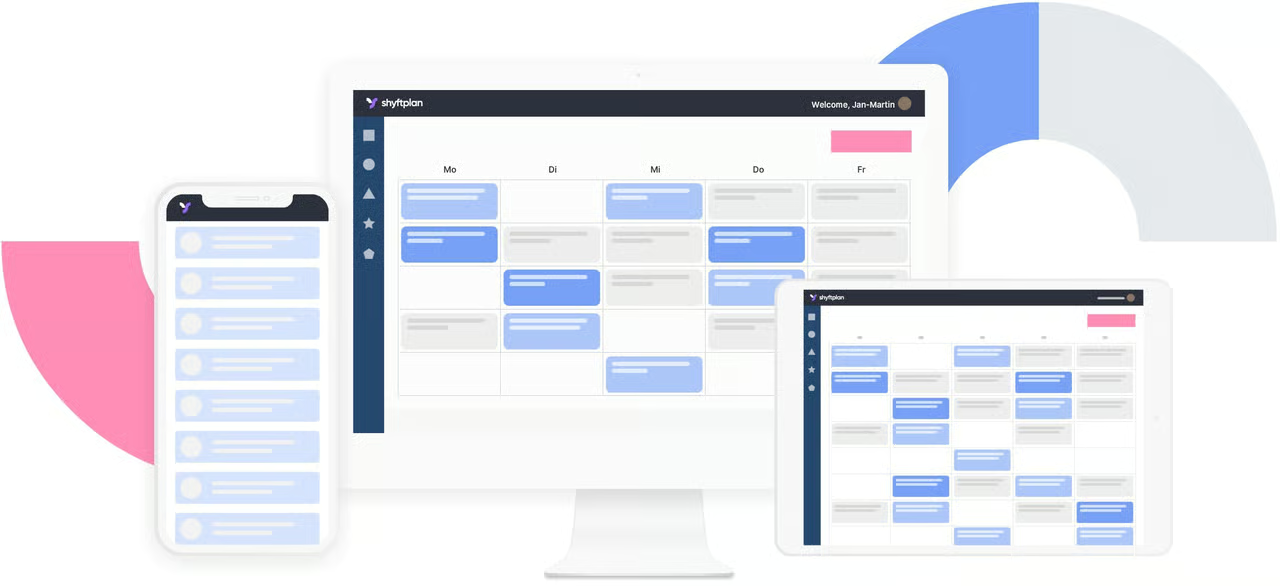
- Higher Employee Satisfaction: Everyone involved is on the same page at all times. Employees can enter their availabilities via mobile devices and swap shifts independently within defined rules.
Strategic Project Note: For detailed insights and exact architecture scenarios regarding the optimal cloud implementation in shift-based operations, navigate directly to our specialized deep dive for Schichtplanung mit SAP SuccessFactors.
SAP On-Premise – Flexibly Connecting Local Installations
Many industrial enterprises operate local on-premise solutions for reasons of data sovereignty or historically grown IT infrastructures. shyftplan can be easily connected to your self-operated systems—regardless of whether you use modern on-premise variants of SAP S/4HANA, the proven predecessor SAP ECC, or older SAP R/3 architectures.Companies thus retain full control over their on-premise hardware and data sovereignty, while planners on the line benefit from the speed advantages of a modern cloud application. A later transition of the company to the full SAP cloud can be implemented effortlessly and without structural modifications at any time thanks to the flexible system architecture.
Bidirectional Connection of Local Modules:
- SAP HCM (On-Premise): The link secures the synchronization of employee master data and absence quotas. It directly connects dynamic workforce scheduling with local time management for error-free payroll accounting.
- SAP APO (Advanced Planner and Optimizer): The program interface allows bidirectional data transfer of manufacturing requirements and machine capacities (including PP/DS components), ensuring that local SCM landscapes also profit from modern AI planning.
Technical Implementation: What Does the Integration Look Like?
- Setting Up the Interface via shyftconnect: The technical link between the SAP world and shyftplan is established via the middle layer shyftconnect, which functions as a standardized interface to the SAP Business Technology Platform (BTP). The data packets are cleanly mapped via the CPI (Cloud Platform Integration). This drastically reduces the project runtime: Instead of months of risky custom coding, the baseline connection is often fully operational within just a few weeks.
- Data Transmission and IT Security Standards: The transmission of all personal and production-critical data takes place via modern, highly encrypted API standards. Employee master data is synchronized cyclically, while acute absences, time management bookings, and operational production data are transmitted in real-time.
Siemens Energy: Efficiency Increase in Practice
The transition to this integrated, digital solution delivers measurable success. At Siemens Energy, automated shift planning with shyftplan led to higher employee satisfaction and greater productivity. Complex planning requirements, unforeseen absences, and fluctuating order requests are effectively managed there under automatic compliance with all legal and tariff-related guidelines.
Can shyftplan be integrated with my existing systems?
Yes, with shyftconnect, you can connect not only nearly all SAP systems but also other common HR and planning tools with shyftplan.

How much does the mobile app for employees cost?
The mobile app for Android and iOS is included in the licensing fee. This means your employees can benefit from it at no additional cost.
For which companies is shyftplan suitable within the SAP environment?
shyftplan is specifically designed for medium-sized and large industrial enterprises with a three- to five-digit number of shift employees who want to optimize and streamline their complex manufacturing processes. For highly complex operations, the system can also be deployed for smaller companies, with a minimum price of €700 per month.