Integrated shift planning for SAP SuccessFactors. Automated and industry-proven.

SAP Time Management and Shift Scheduling: How to Effectively Combine Both
The shortage of skilled labor has definitively arrived in Germany's manufacturing industry. Machines and sometimes entire production lines are increasingly idle, and the pressure is not letting up. According to a study by the German Chamber of Commerce and Industry (DIHK) a year ago, more than 82% of respondents already expected negative consequences for their company because they could not adequately fill open positions.
Added to this is the significant structural change in the key sectors of the domestic industry. The automotive sector is in the midst of a structural transformation with unforeseeable consequences for manufacturers and suppliers. Producers of materials like metal, plastic, and others are under intense international price and competitive pressure. And the Asian market as a whole is in the process of taking significant market shares from German and European manufacturers across various industries.
Against this backdrop, production efficiency is a key factor for competitiveness and future viability. In the manufacturing industry, the available workforce is therefore much more than an abstract cost factor; it is a scarce resource that directly impacts productivity.

Why Flexibility in Shift Operations is Essential
Precise control of working hours is particularly crucial in shift operations. But the reality is complex: flexible shift models, changing overtime regulations, various contract types, and the use of temporary labor make personnel deployment planning a daily challenge.
SAP Time Management provides central functions for this, from time recording to payroll. However, for short-term changes, complex tariff agreements, or cross-location planning, shift scheduling tools should also be used to ensure that operational requirements are optimally considered in the planning.
In these cases, supplementary software for shift scheduling helps to plan the workforce in production more effectively, increase their productivity, and make them more satisfied through proactive involvement in shift scheduling. This makes work on the shop floor run more smoothly, efficiently, and purposefully.
An Overview of SAP Time Management
SAP Time Management is a core component of the SAP Human Capital Management (HCM) module and has existed since the early 1990s. It was developed to help companies efficiently record, manage, and legally map their employees' working hours. Initially available as part of the classic SAP ERP system, it has undergone significant modernization and integration with the evolution of SAP S/4HANA and SuccessFactors.
A central part of this development is Employee Central (EC). This solution offers self-services and is primarily geared towards standardized, globally deployable HR processes. Compared to classic SAP Time Management, however, EC Time Management is less customizable and is better suited for companies with clearly structured time models.
SAP Time Management supports many basic requirements for time recording and processing, including absences, bonuses, and time account management. Through Fiori or the SAP ESS/MSS framework, vacation requests, time accounts, and shift information can also be made accessible on mobile devices, provided these functionalities have been implemented accordingly.
But this is precisely where many companies in shift operations hit their limits. Their planning needs to be adjusted not only regularly but often at short notice:
- Shift changes are cumbersome and slow. If a colleague falls ill or someone wants to swap a shift, it must first be reported via paper or email and then manually entered into SAP. This creates delays, extra costs, and risks of error that burden both production and HR.
- Planning managers have no direct access. Foremen, shift leaders, or supervisors in manufacturing typically cannot or are not allowed to work directly with SAP. Instead, they must communicate their needs through detours, which requires additional coordination.
- There is a lack of overview and flexibility. Anyone who needs to plan at short notice needs a quick overview of availability, vacations, qualifications, and shift distributions. SAP does not offer this transparency, especially not in real-time or in an interface usable by non-HR users.
- Lack of support for spontaneous decisions. In manufacturing, it is often necessary to react within minutes, for example, in the event of machine failures or staff shortages. SAP is designed for compliance and stable processes, but not for ad-hoc decisions in daily business.
Instead of efficient planning, constant inquiries, coordination rounds, and Excel lists arise. This blocks productivity, burdens employees, and creates frustration on the line.
In practice, this often leads to shadow processes that attempt to realize shift scheduling in an SAP environment – for example, by adding Excel. However, since SAP is not designed to map out shift scheduling, you usually end up with just a rigid spreadsheet where shifts can be displayed rather than truly planned. These parallel systems without central governance also lead to increased communication efforts, data inconsistencies, and correction loops.
All of this not only leads to unnecessary extra costs but also to compliance risks and reduced acceptance among employees.
SAP Time Management in Practice: Standardized Processes Work, Shift Scheduling Doesn't
SAP Time Management is particularly suitable for standardized and centrally planned processes. Its strengths lie in the automatic calculation of tariff-based bonuses, integration with payroll, interfaces to time recording systems, and extensive documentation capabilities.
An often-underestimated benefit of SAP Time Management is its extensive reporting functions. Companies can make well-founded decisions based on the recorded working hours and, in combination with SAP Analytics or SAP BW, can also derive strategic HR metrics.
However, especially in shift scheduling, there are numerous requirements that go beyond these standardized application areas. These are a key reason why SAP Time Management is not used for creating shift plans and why many add-ons do not satisfactorily cover this area.
These include, for example, short-term changes to the shift plan, special tariff regulations, detailed visualizations, and self-service functionalities for employees. A central challenge is also the management of overtime.
On the employer side, overtime is often planned deliberately, for example, to react to temporary peaks in demand or to let staff stay home during periods of low utilization. In SAP, this is done through conscious planning of work and compensatory time, sometimes automated through rules in time management.
On the employee side, overtime is often accumulated to later receive additional days off. Time management records these bookings transparently in personal time accounts.
These balance accounts make it possible to manage extra work systematically – whether for granting time off or for payment. However, a forecast that maps the development of overtime is missing.
In practice, this can become critical in the following cases:
- Unplanned overtime forfeiture: If there are no rules regarding the deadline or priority for taking time off, hours expire or are accidentally paid out.
- Uneven distribution in the team: Some employees regularly accumulate high balances, while others are underemployed.
- Complex regulations for shift bonuses: Different bonus models make transparency difficult.
- Conflicts with requests for time off: The desire for free time conflicts with personnel needs or planning bottlenecks.
Such situations usually intensify the use of the aforementioned shadow processes. To avoid this, it is advisable to use SAP Time Management in combination with additional shift scheduling software. This can automate planning, involve employees through self-service offerings, and drastically reduce the proneness to errors in the processes.
By integrating with SAP, both systems can be used for their original use cases to cover all internal processes and requirements. This results in an integrated solution that actively contributes to better utilization, increased transparency, and legally compliant documentation.
Anyone Who Wants to Plan Shifts Correctly in Industry Needs a Dedicated Solution
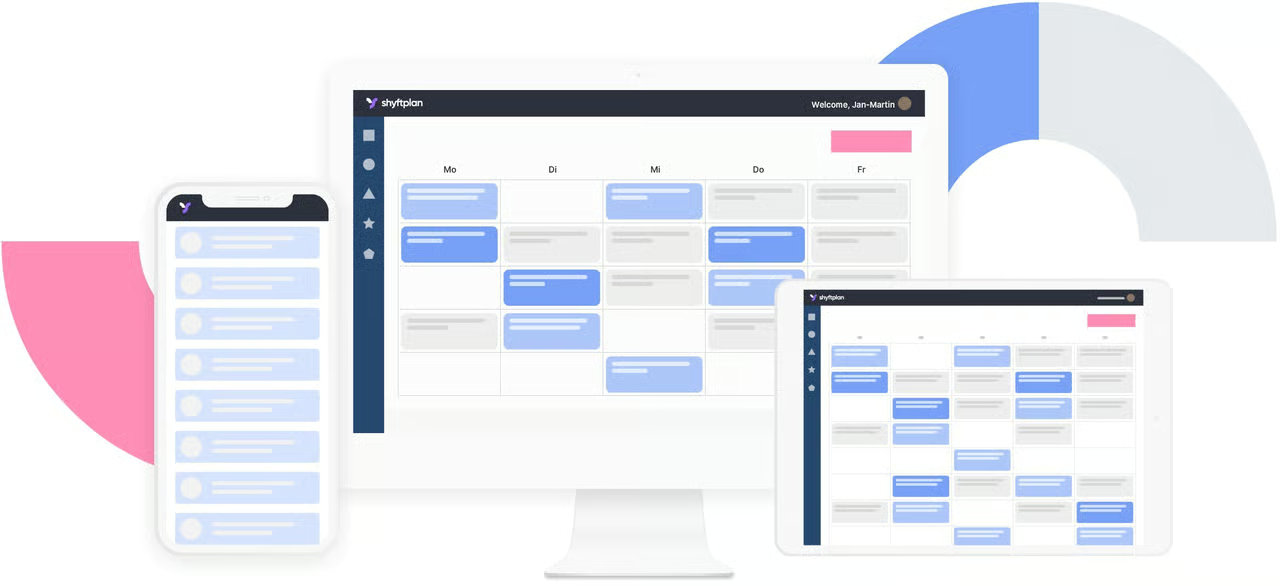
A dedicated shift scheduling tool like shyftplan is a valuable addition when it comes to reacting flexibly and in compliance with changing conditions. Numerous functions that go well beyond what SAP Time Management offers help to take shift scheduling in production to a new level. The result is a noticeable workload reduction for managers and staff. This is reflected in:
- Growing Productivity:
By optimally staffing shifts, lines, and machines, the maximum can be extracted from production. The existing personnel is perfectly utilized, and downtime of machines or entire shifts is avoided. In addition, workflows can be adapted transparently and at short notice to changing conditions or order volumes.
- Cost Savings:
Permanent staff can be planned purposefully, avoiding unnecessary overtime and extra work. And external staff such as temporary workers can be deployed in such a way that the costs incurred are precisely aligned with the demand.
- Increasing Staff Satisfaction:
Transparency in shift assignment. Easy requests for shift swaps and vacation. Communication at eye level through a mobile app. A say in shift scheduling. All these topics ensure that the employees to be scheduled on the shop floor are engaged in the planning process and feel involved. This has a direct impact on their satisfaction, which in turn leads to a lower staff turnover rate.
- Ensured Compliance:
Automated planning ensures that all legal requirements are automatically met. And if an audit is due, all relevant data is centralized and easily retrievable, without having to rely on the knowledge of individual employees and their manual documentation.
- Planning Optimization:
By avoiding planning errors, business continuity is ensured in the short and long term. Since all relevant data is centrally available, inconsistencies when transferring data between multiple systems are avoided, and planning efficiency is noticeably increased.
- Process Automation:
Both the planning processes themselves and the required feedback loops are significantly shortened. Thanks to this reduced coordination effort, planners can concentrate more on the things that really matter - things that only a skilled human can do. The rest is taken over by the machine, which now takes care of the redundant processes.
Achieving Excellence with a Targeted Extension
SAP Time Management forms a solid foundation for working time administration. But those who want to succeed in shift operations need more: flexible planning options, transparent communication, and future-proof systems. A targeted addition with an integrable planning tool closes these gaps.
Considering the increasing demands for agility, compliance, and data sovereignty, it becomes clear: only those who question standard processes and expand them in a targeted way can use time management as a real competitive advantage.
Optimized Workforce Planning with SAP SuccessFactors and shyftplan
Linking shyftplan with SAP SuccessFactors creates a powerful solution for modern workforce planning that helps to avoid bottlenecks and increase efficiency. The interplay of these systems automates numerous processes. These include, for example, the synchronization of absences, AI-supported suggestions for replacements, and the automatic consideration of relevant legal requirements. Companies benefit from a seamless data exchange that not only significantly improves operational efficiency but also ensures compliance with all labor law provisions. Discover how your company can benefit from this powerful combination.
Who is allowed to view the shift schedule?
Regarding data protection, the law is clear on work schedules: not every employee is entitled to view the entire shift schedule. Similarly, every employee has the right to prevent the publication of the schedule—even within the company.

How much does shyftplan cost?
The total price for your company consists of the licensing fee for either the Professional or Enterprise package and the number of employees to be scheduled. Feel free to contact us for a specific quote. Apart from the licensing fee, there are no additional costs with Shyftplan. This way, you benefit from a clear Total Cost of Ownership (TCO).
What types of companies is shyftplan suitable for?
shyftplan is designed for companies with a three- to five-digit number of shift employees. If needed, shyftplan can also be used for companies with fewer employees. However, please note the minimum price of €700 per month.